Information unaudited Information ungeprüftCorporate governance and integrity
We take a values-oriented approach to corporate governance. Compliance with laws and regulations is a matter of course for us. We also take targeted measures to enhance the corporate culture, practise effective compliance management and offer protection to whistleblowers.
The values of “integrity”, “respect”, “passion” and “excellence” underpin the system of value-driven corporate governance within the LLB Group. Through the implementation of comprehensive regulations and targeted measures, we promote fairness, transparency and responsibility. At the same time, we support employees in ensuring that their behaviour is ethical and compliant. We have also implemented a holistic reporting system that makes wrongdoing transparent with the aim of avoiding further wrongdoing in the future.
1 General information
In the course of the double materiality assessment, we identified the following key impacts and opportunities that relate to the corporate culture within the LLB Group:
- The LLB Group’s value-driven corporate culture has a positive impact on our employee satisfaction. It encourages the development of new ideas, supports responsible conduct and creates the space needed to openly deal with errors. These effects are clearly reflected in our regular employee surveys. Due to the existing measures and our continual commitment, we assume that these positive impacts will persist not just over the short term, but over the medium and long term too.
- Our value-driven corporate culture represents an opportunity for the LLB Group. It consolidates trust in the LLB Group as a safe bank and, in this way, makes us an attractive potential employer to qualified applicants. As a result, we are well positioned to remain strong in competing for the best talent. While the positive financial impacts cannot currently be quantified in specific terms, we feel there is potential here over the short, medium and long term.
- Through the effective protection of whistleblowers, we play a key role in uncovering and combating misconduct. Employees of LLB Group companies benefit directly from this. Protecting whistleblowers also strengthens our value-driven corporate culture and has a positive effect on our clients and investors. On account of legal obligations and the LLB Group’s high level of dedication in this area, we assume that these positive effects will be observable over the short, medium and long term.
Our strategies and measures are designed to promote our value-driven corporate culture in a targeted way and ensure the protection of whistleblowers. This enables us to further improve employee satisfaction, prevent misconduct within the bank as much as possible and simultaneously boost trust among our clients.
2 Corporate governance policies
2.1 Policies relating to our corporate culture
In addition to our corporate strategy and structure, we consider corporate culture to be one of the most important factors in our success. In 2023, we updated the existing qualitative guiding principles that define the framework of standards for our employees, providing the basis for how to act on a day-to-day basis. Our guiding principles consist of three elements:
- Purpose: This defines LLB’s raison d’être, apart from making a profit, and describes the overall contribution our bank makes to society and the environment. The purpose spells out to employees the basic point of their work and gives them a sense of focus. It also explains why certain values and requirements need to be observed.
- Vision: This is our Pole Star, which guides us as we go about our daily work. Its power lies in the way it describes an objective. It inspires and motivates us to achieve this objective.
- Values: These are the guidelines and benchmarks for decisions and innovations and enhance both customer loyalty and reputation. By giving us focus, they help us find answers to the most varied and complex questions.
Framework of standards for the LLB Group
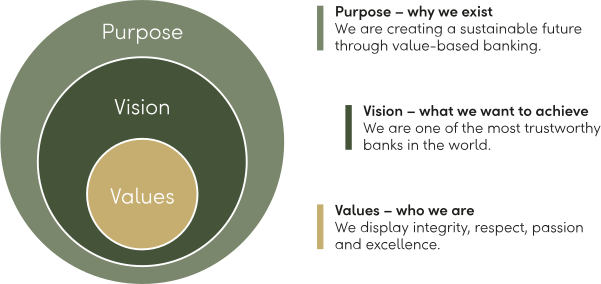
We use various formats to share our framework of standards with new employees as soon as they join. This framework was developed by Group Marketing, with input from the Group Executive Board, Group Corporate Communications and Group Human Resources (HR). The process included interviews and a workshop involving various business areas at the LLB Group. The Board of Directors was also involved in the process.
What our qualitative guiding principles mean for day-to-day operations is specified in numerous internal documents:
2.1.1 Our Code of Conduct
A key corporate governance instrument is the LLB Group’s Code of Conduct. It defines the kind of behaviour we expect from our employees at every level. It also provides a reliable framework for focusing on values-based and responsible action that meets statutory requirements as well as ethical and social standards. It is therefore a binding and collective requirement for all employees of LLB Group companies. The Group Legal & Regulatory business area is responsible for implementation.
The Code helps us maintain our standing and our credibility in the eyes of customers, investors, the authorities and the public. Minor violations of the Code of Conduct are assessed by the respective line manager with the relevant HR business partner; serious violations are dealt with by the Integrity Committee (see section Integrity Committee). Our Code of Conduct applies Group-wide and is publicly available on the LLB Group’s website. It can also be accessed via LLB’s internal Intranet.
2.1.2 Compliance management and conflicts of interest
Together with the Code of Conduct, the Group regulations on “Compliance management” and “Management of conflicts of interest” provide the foundations for our strong, ethics-based corporate culture. They apply Group-wide and can be accessed via LLB’s internal Intranet in the collected body of rules and regulations.
Our “Compliance management” Group regulation builds on the Code of Conduct. It forms the foundation for how compliance is organised at the LLB Group and presents a consistent and clear picture of how compliance is integrated and practised within our business. Consistent implementation and monitoring of the Group regulation ensure compliance with all legal and regulatory requirements. The Group regulation is binding for all Group companies. It also governs the issue of whistleblowing. The Group Legal & Regulatory organisational unit is responsible for the content.
Our Group regulation on “Management of conflicts of interest”, which also builds on the Code of Conduct, defines for employees a set of rules of conduct and measures for how to identify and deal with conflicts of interest. The Group Regulatory Compliance department is responsible for the content. Our aim is to identify these conflicts at an early stage and create transparency around them, so they can be managed and kept under control. We want to minimise risks and ensure decisions are made with integrity. The rules also help prevent bribery and corruption. The LLB Group does not operate an anti-corruption strategy consistent with the approach set out by the United Nations.
We take a consistent approach to countering greenwashing by ensuring that all sustainability statements made in accordance with the Code of Conduct are truthful, verifiable, up to date and not misleading, and that a high level of data quality is guaranteed. Greenwashing risks are systematically addressed in three areas – financial products, the provision of financial services as well as organisation and communication – with clear responsibilities, training and controls. Compliance with these requirements is monitored on a Group-wide basis.
If employees observe violations of the regulations, they may – as an alternative to the whistleblowing channel – inform in person or by phone a trusted person, their line manager, the General Counsel, the Head of Group Internal Audit or the Head of Group Human Resources. Group Internal Audit and Group Regulatory Compliance perform ongoing checks, including to uncover any wrongdoing. Group Legal & Regulatory is responsible for the initial assessment of reports. Any further investigation is undertaken by the respective organisational unit together with Group Human Resources. Serious violations are dealt with by the Integrity Committee.
2.2 Policies for protecting whistleblowers
Banks must ensure legal compliance in order to gain customers’ trust and minimise any financial risks. Whistleblowers help us identify potential misconduct at an early stage and allow prompt intervention. It is therefore crucial that they are protected. Employees with information on potential impermissible behaviour are able to report this internally at the bank. Reports may be submitted verbally, in writing or electronically, either openly or anonymously. This is done via what is known as the Trusty Tool, our whistleblowing tool, or instead by contacting one of the local whistleblowing offices. These contact persons are based at all Group companies. A dedicated Intranet page provides information on our whistleblowing tool and contains a list of local contact persons.
The protection of whistleblowers is guaranteed by the Group regulation “Compliance management”. This regulation:
- defines the responsibilities of the Integrity Committee and the whistleblowing offices;
- provides an outline of the reporting process;
- stipulates the need for confidentiality and for whistleblowers to be protected;
- sets out the internal reporting obligations of the General Counsel.
The regulation is binding for all Group companies. At LLB Österreich, the manual for the whistleblower system also applies. The Group Legal & Regulatory business area is responsible for the content.
The so-called Whistleblower Directive (EU) 2019/1937 has not yet been implemented in Liechtenstein. However, we have adopted a proactive approach and implemented the corresponding requirements. The Whistleblower Directive has been integrated into national law in Austria and Germany.
2.2.1 Integrity Committee
If the LLB Group receives reports from whistleblowers regarding incidents or violations, they are dealt with by the Integrity Committee, which operates from a central location at the LLB parent bank. Under certain circumstances the report is forwarded to the local responsible persons at the Group companies. The Integrity Committee investigates tip-offs that come in through the relevant whistleblowing channels, although it may also take action on its own initiative. If a report comes in, it may take the following measures:
- investigation of the matter, if the local whistleblowing office has not done this already;
- assessment of whether a violation of laws, regulations, good faith, basic decency or similar is involved;
- implementation of necessary protective measures for the whistleblower and for the individuals or office named by them.
If the Integrity Committee concludes there has been a violation of regulations, it may take further steps in accordance with the Group regulation on “Compliance management”. In the case of minor discretions, the line manager together with Group Regulatory Compliance and the relevant HR Business Partner decide on the necessary disciplinary measures. For serious violations, the Integrity Committee in consultation with the relevant business area head is responsible for handing down the punishment (see section Whistleblowing tool).
The Committee consists of the General Counsel (Chair), the Head of Group Human Resources, the Head of Group Business Risk Management and the Head of Group Internal Audit. In the interest of all concerned, processes are conducted independently, objectively and promptly. The Integrity Committee meets as required, but at least every quarter.
Even when reports are made openly, the name of the whistleblower is kept strictly confidential. External whistleblowers can also submit reports via the Trusty Tool directly. As well as this, they can access a feedback form on our website, where they can provide feedback and also make complaints.
2.3 Other relevant policies
Alongside the above-mentioned directives and regulations, there are also other internal policies on key issues such as market misconduct, money laundering and anti-terrorism, dealing with sanctions as well as data protection and information security. These policies offer comprehensive protection against risks that are especially relevant to the banking industry. All policies are available for all employees to access via the LLB Intranet in the collected body of rules and regulations. We also always provide notification by way of an Intranet article as soon as any regulation is approved by the Group Executive Board or Board of Directors. Individual policies are communicated as part of specific training sessions.
The risk arising from potentially illegal conduct – including corruption and bribery – is inherently high in the financial sector. As a responsible financial institute, we have implemented regulations and preventative measures to mitigate this risk. Employees in client-facing roles are placed under the microscope in view of active bribery and corruption, for example through the offering of gifts in the context of client acquisition or account management. With passive bribery – that is, the acceptance of gifts – members of senior management in particular who have the relevant competence to authorise expenditure as individuals or as management bodies are potentially at risk.
3 Measures relating to governance
3.1 Measures relating to our corporate culture
Two key instruments help us bring our value-driven corporate culture to life and give all employees a sense of focus: the cultural journey and ongoing training courses on ethical and legal issues.
3.1.1 Cultural journey
In 2017, we came up with what we call the cultural journey, which we use to motivate employees to think about their behaviour, share ideas and suggest potential changes to processes. The purpose of this programme is to keep on developing the corporate culture in line with our business strategy. Suitable measures are taken in relation to a focus topic, which takes into account the strategic direction.
The current emphasis is a focus on customers and results (or KEO, after the German phrase Kunden- und Ergebnisorientierung). The aim is to integrate KEO into the corporate culture. First of all, workshops were held for all employees across the Group, with a view to developing a common understanding of KEO. To build on this, they were given the opportunity to include individual objectives in their agreed personal objectives (for staff appraisal purposes). Managers are supported by a range of instruments, intended to make KEO more relevant to people’s day-to-day experience. The second phase, which began in 2024, involved a KEO camp for all managers. Here, progress made so far was measured and the KEO check was introduced (and training provided). The check includes a structured checklist covering the issues of collaboration and focusing on customers and results. The introduction of the KEO check commenced in the fourth quarter of 2024.
Then in 2025, various measures designed to promote the “cultural dialogue” were implemented. The KEO barometer was carried out for the third time (survey to evaluate the change in corporate culture and determine the mood among employees). Following this, line managers were requested to discuss the results with their teams and were given support to do so. At the employee level, a culture club was also launched. This culture club takes the form of an open, moderated roundtable focusing on current topics and their impact on the culture within the LLB Group.
3.1.2 Training of our employees
As part of the onboarding process, we provide training for all employees on issues of statutory relevance, such as due diligence, conflicts of interest, compliance management, dealing with customers in relation to tax matters and cross-border provision of services. In doing so, we ensure they are familiar with the relevant laws and that our own requirements are met – in terms of business being conducted in the correct manner. New employees must complete all training courses of importance to their area of activity within three months of joining.
Our customer advisers undergo annual training on due diligence and the Markets in Financial Instruments Directive (MiFID) or the Swiss Financial Services Act (FinSA). They also need to be familiar with the supervisory provisions of the countries where the customers they serve are domiciled. Mandatory country-specific training courses must be completed with this in mind. These set out which services and activities are permitted in terms of customer acquisition and customer service for customers who visit bank premises, are looked after on a cross-border basis or receive visits at home.
A further training course for all employees on conflicts of interest deals with the issues of employee transactions, disclosing conflicts of interest, accepting and offering gifts and secondary occupations. This training course is repeated every year. As regards our other training courses, the party creating them decides how often they need to be repeated. The typical cycle is every two to three years.
Finally, in 2025 a Group-wide training session on our Code of Conduct was rolled out. All employees and line managers completed an interactive training course on current issues relating to sustainability. This course also included a short test to check understanding. LLB runs ad hoc training courses as required, for example when regulatory or practical changes are introduced.
3.2 Measures relating to the protection of whistleblowers
The Group regulation “Compliance management” stipulates that reprisals against whistleblowers are prohibited. Information concerning the identity of whistleblowers is treated with strict confidentiality. Further protective measures may be decreed by the Integrity Committee.
The identity of the whistleblower and other information that may help reveal their identify may only be disclosed to the persons responsible for receiving reports and taking any subsequent measures. The only possible exception is if a necessary and proportionate disclosure obligation applies in relation to investigations by national authorities or legal proceedings. The whistleblower should generally be informed about this in advance.
Our employees are made aware of and informed about whistleblowing. The last training course on this issue was held in autumn 2023; so far, nothing has been decided as to how often it should be repeated. The training is mandatory for new employees. We have not implemented any specific training for members of the Integrity Committee.
4 Targets and key figures relating to governance
4.1 Targets and key figures relating to our corporate culture
We have not specified any measurable, results-based and time-bound targets in relation to the sustainability topic of “Corporate culture”. Notwithstanding this fact, we monitor the effectiveness of our measures on an ongoing basis. A key tool is the regular employee survey, which provides us with valuable insights into the satisfaction of our employees. We have not set any specific targets in this regard; however, we strive to achieve a steady improvement with each employee survey carried out. The turnover rate as well as structured exit interviews also give indications as to potential need for improvement. We gain more understanding about LLB’s attractiveness as an employer during job interviews. The turnover rate is recorded monthly; a qualitative assessment is carried out quarterly (see chapter Own workforce).
4.2 Targets and key figures relating to the protection of whistleblowers
We have not specified any measurable, results-based and time-bound targets in relation to the sustainability topic of “Protection of whistleblowers”. Notwithstanding this fact, we monitor the effectiveness of our measures on an ongoing basis. Reports of impermissible behaviour are recorded and referred to the Group Executive Board and the Board of Directors from 2026, for the previous financial year in each case, either in the activity report or in the risk analysis. These list the number of reports for each Group company, along with the main findings and measures resulting from the reports. In the year under review, two reports were received via the whistleblowing tool. Neither report resulted in fines, external sanctions or compensation payments. We have not defined any targets for the number of reports.